Leave Your Message
For global buyers, choosing a Water Heatpump is not simply a purchase decision. It is a long-term investment in hot water reliability, energy management, and operational resilience. In a hotel, factory, apartment building, or rural home, the system must perform through changing weather, water demand, and electricity conditions. That reality makes product selection more complex than comparing advertised efficiency figures.
Thomas Nowak, Secretary General of the European Heat Pump Association, has stated, “Heat pumps are a key technology for the decarbonisation of heating.” His view reflects the wider role of heat pump technology, but buyers should examine practical details carefully. A Water Heatpump can recover useful heat from air, water, or another available source. It may reduce operating costs and support lower-carbon heating when paired with cleaner electricity. Results still depend on climate, installation quality, maintenance, and usage patterns.
Small details matter. A coastal hotel may need corrosion-resistant components. A cold-region facility may require reliable low-temperature performance. Hard water can affect heat exchangers over time. Noise levels matter near bedrooms. Local refrigerant rules and electrical standards also require professional checking.
No technology is flawless. An oversized unit can cycle inefficiently. A poorly designed system can disappoint even when its specifications look impressive. Global buyers should request verified performance data, warranty terms, service availability, and realistic lifecycle estimates. Independent testing helps, too. The best Water Heatpump is not always the most powerful model; it is the one properly matched to the site, demand, climate, and local support network.
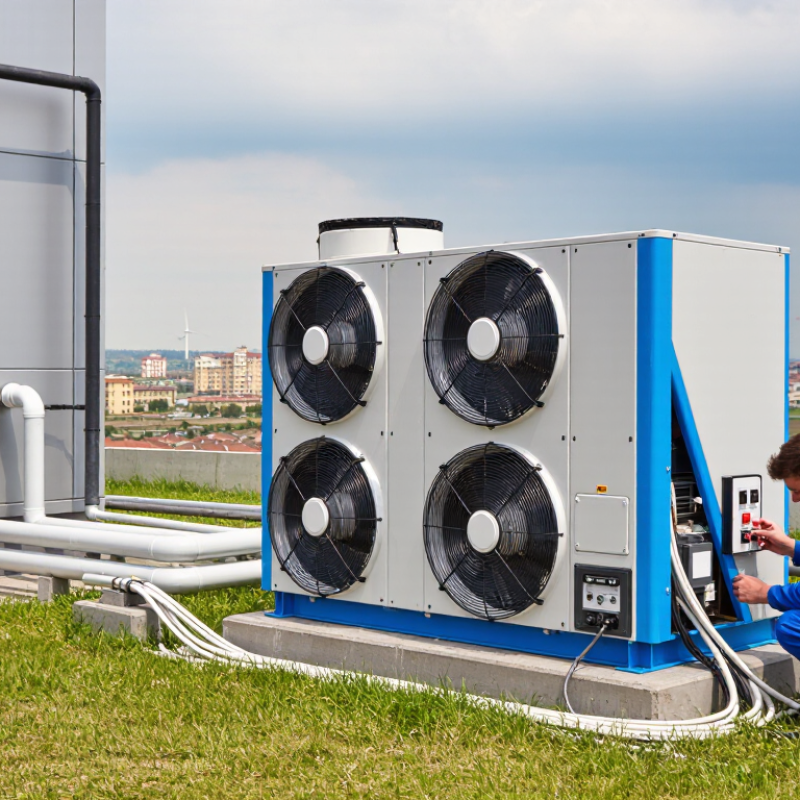
A water heat pump transfers heat rather than creating it through combustion. It uses a water source, such as groundwater, a lake loop, or a closed building circuit. The evaporator absorbs low-temperature heat from water. The compressor raises the refrigerant’s pressure and temperature. The condenser then releases useful heat for space heating or hot water. Finally, the expansion valve lowers refrigerant pressure, restarting the cycle.
Water temperatures usually change less than outdoor air temperatures. This stability can support steady performance during cold weather. The U.S. Department of Energy reports that geothermal heat pumps can reach efficiencies three to six times higher than conventional heating systems. Results depend on flow rate, exchanger design, insulation, and electricity quality. Small details matter.
The International Energy Agency’s The Future of Heat Pumps report states that heat pumps could reduce global carbon dioxide emissions by at least 500 million tonnes annually by 2030. That potential is significant, but installation is not automatically simple. Groundwater chemistry may cause scaling or corrosion. Local permits may control water extraction and discharge. A poorly sized system can waste energy, even with excellent equipment. Buyers should request measured source-water temperatures, seasonal COP data, maintenance records, and independent performance testing. Manufacturer claims alone are not enough. Some project estimates still look too optimistic.
| Data Dimension | What It Means | Typical Real-World Information | Why It Matters to Global Buyers |
|---|---|---|---|
| Basic Definition | A water heat pump transfers heat rather than generating heat directly by burning fuel or using resistance elements. | It can use heat from outdoor air, the ground, or a water source to heat domestic water or a hydronic heating circuit. | The technology can reduce energy consumption and is adaptable to different climates and building systems. |
| Main Operating Principle | A refrigeration cycle moves low-temperature heat to a higher-temperature water system. | The evaporator absorbs heat, the compressor raises the refrigerant temperature, the condenser transfers heat to water, and the expansion device reduces refrigerant pressure. | Understanding the cycle helps buyers evaluate efficiency, installation requirements, and service needs. |
| Common Heat Sources | The heat source is the environment from which the system extracts thermal energy. | Air-source systems use outdoor air; ground-source systems use soil or groundwater; water-source systems use a suitable water loop or body of water. | Local climate, available land, water regulations, and installation cost determine the most suitable configuration. |
| Typical Coefficient of Performance (COP) | COP is the ratio of useful heat output to electrical energy input under specified test conditions. | Many heat pumps show a COP of approximately 2.5–5.0 under favorable conditions. Actual performance changes with source temperature, water temperature, and system design. | A higher COP generally means lower electricity use, but buyers should compare results tested under equivalent standards and conditions. |
| Seasonal Efficiency | Seasonal performance reflects operation across changing outdoor temperatures and heating demand. | Seasonal efficiency is commonly evaluated using metrics such as SCOP or seasonal COP rather than a single laboratory COP. | Seasonal data provides a more realistic basis for estimating annual operating costs in different regions. |
| Water Temperature Range | The required water temperature affects efficiency and equipment selection. | Low-temperature space-heating systems often operate around 30–45°C, while domestic hot-water systems commonly require approximately 50–60°C. Exact limits depend on system design. | Lower water temperatures usually improve efficiency, so underfloor heating and properly sized radiators can be advantageous. |
| Heating Capacity | Capacity is the rate at which the heat pump supplies useful heat, normally expressed in kilowatts (kW). | Residential systems may range from roughly 4–20 kW, while larger commercial installations can require substantially higher capacity. | Correct sizing prevents excessive cycling, insufficient heating, unnecessary costs, and premature component wear. |
| Performance in Cold Weather | Air-source performance decreases as outdoor temperature falls because less heat is available and the compressor works harder. | Modern systems can operate below 0°C, but heating capacity and COP vary by model and test condition. Defrost cycles may be required in humid, cold weather. | Buyers in cold climates should check low-temperature capacity, operating limits, backup heating, and seasonal performance data. |
| Energy Input | The system normally uses electricity to operate the compressor, fans, pumps, controls, and auxiliary heaters. | For a COP of 4.0, approximately 1 unit of electricity can deliver 4 units of heat under the stated operating conditions. | Operating-cost savings depend on electricity tariffs, climate, water temperature, maintenance, and the efficiency of the existing heating system. |
| Carbon Emissions | A heat pump has no on-site combustion emissions during normal operation. | Total carbon impact depends on the electricity-generation mix, system efficiency, refrigerant, equipment lifetime, and manufacturing impacts. | The environmental advantage is generally greater where electricity contains a high share of renewable or low-carbon generation. |
| Hot-Water Hygiene | Domestic hot-water systems must be designed and operated to control bacterial growth, including Legionella risk. | Some systems use periodic high-temperature cycles or an auxiliary heater to meet hygiene requirements; local regulations should be followed. | Proper storage temperature, circulation, controls, and maintenance are essential for safe domestic hot-water production. |
| Best-Fit Applications | Heat pumps can support domestic hot water, space heating, swimming pools, process water, and combined heating and cooling systems. | They are particularly suitable for well-insulated buildings, low-temperature heating networks, new construction, and projects seeking reduced fossil-fuel use. | Application suitability should be confirmed through a site survey covering load, climate, water quality, noise, space, electrical supply, and local codes. |
Note: Performance values are typical industry ranges and are not guarantees. Actual results depend on climate, design conditions, installation quality, controls, maintenance, and local energy prices.