Leave Your Message
AI Helps Write

2026 Top Heat Pump Heater Types for Global Buyers

Choosing the right Heat Pump Heater in 2026 requires more than comparing advertised heating capacity. Global buyers must consider climate, building insulation, electricity prices, installation skills, maintenance access, and local energy standards. A system that performs well in a mild coastal city may struggle during a dry winter or severe frost. Real-world performance matters.

This guide examines leading heat pump heater types, including air-source, ground-source, water-source, hybrid, and high-temperature models. Each option has practical strengths and limits. Air-source units are often easier to install, while ground-source systems can deliver steadier seasonal efficiency when land and drilling budgets allow. High-temperature models may suit older buildings with existing radiators, but they can consume more electricity under demanding conditions.

Look beyond the catalog.

Experienced buyers should check seasonal efficiency data, operating temperature ranges, noise ratings, warranty terms, refrigerant information, and installer qualifications. Manufacturer claims are useful, but field conditions can change results. A poorly sized unit may cycle too often, produce uneven comfort, or require expensive backup heating. That is easy to overlook.

The article also considers regional purchasing decisions, from compact residential systems to larger commercial solutions. It explains how coastal humidity, dusty environments, limited service networks, and unstable power supplies may influence model selection. Standards and product availability differ by country, so professional local verification remains essential. No comparison can replace a site survey. Still, a careful framework can reduce costly mistakes and support a more reliable long-term investment.
2026 Top Heat Pump Heater Types for Global Buyers

What Is a Heat Pump Heater and How Does It Work?

A heat pump heater transfers heat instead of generating it directly. That difference explains its efficiency. Even cold outdoor air contains usable thermal energy. The system captures that energy through a refrigerant cycle.

The outdoor coil acts as an evaporator. Refrigerant absorbs heat and changes into a gas. A compressor then raises its pressure and temperature. Inside the building, the condenser releases heat through air ducts, radiators, or a water tank. An expansion valve lowers the refrigerant pressure, and the cycle starts again. It moves heat.

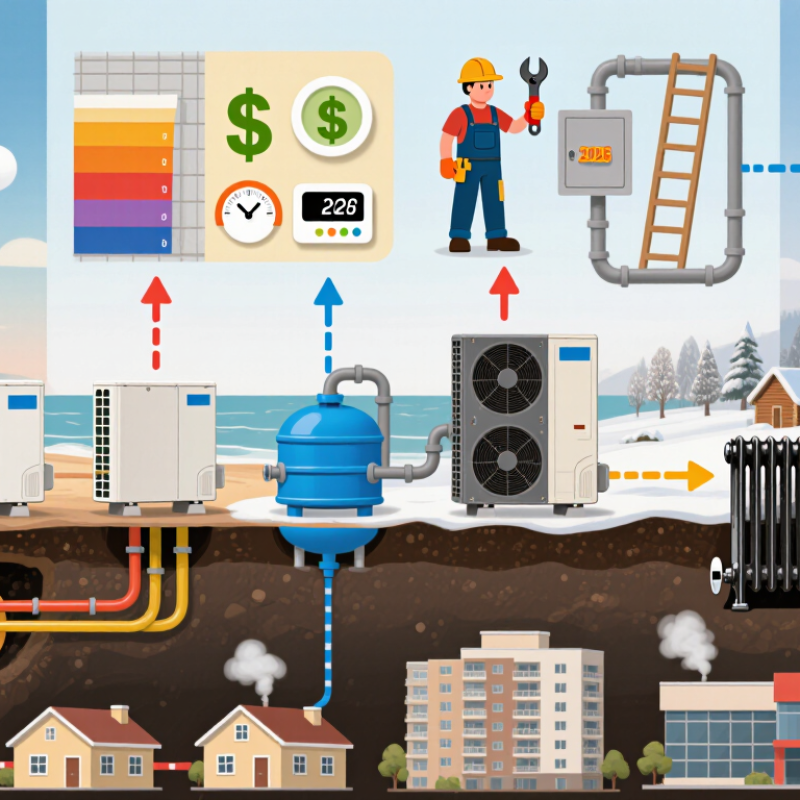
Air-source units draw energy from outdoor air. Ground-source systems use stable underground temperatures.

Water-source designs transfer heat from suitable water loops. Each type suits different buildings, soil conditions, installation budgets, and local climates.

A practical check involves the outdoor coil, airflow, insulation, and control settings. Poor airflow can reduce output, even when the equipment is correctly sized. During freezing weather, the unit may enter defrost mode and briefly stop heating. This is normal, but frequent defrosting deserves investigation.

The term “heater” is slightly misleading. A heat pump also needs electricity, and its performance changes with outdoor temperature. A high efficiency rating on paper does not guarantee the same result in every home. Real comfort depends on installation quality, building heat loss, and sensible maintenance. The simple explanation hides those details.

Main Heat Pump Heater Types Available in 2026

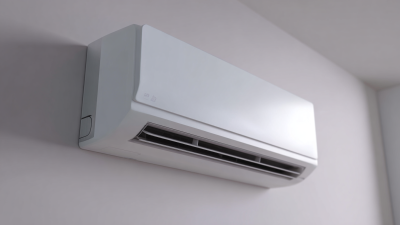
In 2026, air-source heat pumps remain the most accessible heater type for global buyers. They extract heat from outdoor air, even during cold weather. Modern cold-climate models can support homes below freezing, but output usually drops as temperatures fall. A wall-mounted indoor unit suits a small room, while ducted equipment serves several rooms. Proper sizing matters more than a large capacity label.

Ground-source heat pumps use buried pipes to exchange heat with stable underground temperatures. They usually deliver steadier performance, especially in regions with harsh winters. However, installation may require drilling or significant land area.

Water-source systems work similarly, using a suitable lake, well, or groundwater loop. Site testing is essential. Poor soil or water conditions can make an attractive design impractical.

Hybrid systems combine a heat pump with another heating source, often for peak winter demand. This option can reduce strain on the heat pump, though controls become more complicated.

Heat pump water heaters are another major category, using ambient air to heat a storage tank. They fit utility rooms, but need airflow and produce a gentle fan sound.

Buyers should compare seasonal efficiency, operating temperature range, noise data, warranty terms, and local service skills. Some published performance figures look impressive, yet may not match a drafty house or weak electrical supply. A careful load calculation is still the part many projects underestimate.

How Different Heat Pump Systems Compare in Performance

2026 Top Heat Pump Heater Types for Global Buyers

For global buyers, heat-pump performance depends on climate, building design, and installation quality. Air-source systems are usually easier to install and cost less upfront. However, their efficiency can drop during freezing weather or defrost cycles. Ground-source systems use stable underground temperatures, so they often deliver steadier seasonal performance. Water-source systems can perform strongly where a suitable water body or loop is available. The best type is not universal.

The U.S. Department of Energy reports that heat pumps can deliver up to three units of heat for each unit of electricity consumed. That figure describes efficient operating conditions, not every home. The International Energy Agency’s report, The Future of Heat Pumps, estimates that wider adoption could reduce global carbon dioxide emissions by at least 500 million tonnes in 2030. Actual results depend heavily on refrigerant choice, controls, insulation, and electricity sources.

Cold-climate air-source systems can maintain useful heating output, but efficiency falls as outdoor temperatures decline. Ground-source systems usually provide steadier seasonal efficiency, although drilling can raise project costs. Water-source designs may achieve strong performance, but local permits and water conditions matter. Hybrid systems add resilience during extreme cold, yet they require careful controls and maintenance. Buyers should compare seasonal COP, low-temperature capacity, noise, and tested field data. One weakness remains: published COP values rarely reflect a drafty building, blocked airflow, or neglected filters. Real bills can differ sharply.

Key Factors for Choosing a Heat Pump Heater Worldwide

2026 Top Heat Pump Heater Types for Global Buyers

Choosing a heat pump heater worldwide requires more than comparing prices. Air-source systems suit many homes because installation is usually simpler and less expensive. However, their output can fall during freezing weather. Ground-source systems provide steadier performance, but drilling or trenching requires suitable land, permits, and higher initial investment. Water-source models can work efficiently near reliable water resources, subject to local environmental rules.

Climate should guide the decision. Check the unit’s rated capacity at your area’s lowest design temperature, not only its headline output. A high coefficient of performance may look attractive, but real efficiency changes with outdoor temperature, defrost cycles, water temperature, and household habits. Choose low-temperature radiators or underfloor heating where possible. Oversized equipment may cycle frequently and waste energy.

Installation quality matters as much as the machine. Ask for heat-loss calculations, seasonal efficiency data, noise measurements, and refrigerant information. Confirm electrical requirements before ordering, especially in regions with unstable grids. A qualified installer should explain drainage, frost protection, filter cleaning, and yearly inspection needs. In practice, buyers sometimes focus too heavily on the purchase price. That can be a costly mistake. Yet the most expensive system is not automatically the best; local labor, spare parts, climate, and building insulation may matter more. Think carefully.

2026 Top Heat Pump Heater Types for Global Buyers - Key Factors for Choosing a Heat Pump Heater Worldwide

Heat Pump Heater Type Heat Source & System Design Typical Heating COP* Typical Operating Conditions Best Climate & Applications Main Advantages Key Limitations Important Buying Factors
Air-Source Split Heat Pump Outdoor air-to-refrigerant unit connected to an indoor coil, air handler, or fan-coil system. Approximately 3.0–5.0 at 7°C outdoor temperature and 35°C supply temperature. Heating commonly available from about −20°C to 24°C, depending on model and controls. Temperate, warm, and moderately cold regions; suitable for homes, apartments, offices, and small commercial buildings. High installation flexibility, efficient cooling and heating, relatively low site work, and compatibility with many indoor distribution systems. Heating capacity and efficiency decrease as outdoor temperature falls; outdoor defrost cycles may temporarily reduce output. Low-temperature capacity, minimum operating temperature, sound level, defrost control, local electrical supply, and refrigerant compliance.
Air-Source Monobloc Heat Pump Most refrigeration components are located outdoors; water or glycol piping connects the unit to indoor heating equipment. Approximately 2.8–4.8 at 7°C outdoor temperature and 35°C supply temperature. Often designed for space heating and domestic hot water, with supply temperatures commonly around 30–55°C. New construction and retrofit projects where a hydronic heating system is preferred. No indoor refrigerant circuit is normally required, simple indoor layout, and good integration with underfloor heating or radiators. Outdoor water piping requires freeze protection; higher water temperatures reduce efficiency. Pipe insulation, glycol or freeze-protection strategy, hydraulic design, buffer-tank requirements, and backup-heater control.
Cold-Climate Air-Source Heat Pump Enhanced air-source design using variable-speed compression, optimized refrigerant circuits, and low-temperature control logic. Approximately 1.8–3.0 at −15°C outdoor temperature and 35°C supply temperature; higher at milder conditions. Selected models can operate near −25°C to −30°C, but available capacity varies significantly by design. Cold and continental climates, including regions with prolonged winter heating demand. Maintains useful heating capacity at low outdoor temperatures and can reduce dependence on fossil-fuel heating. Higher purchase cost, greater defrost demand, and possible need for supplemental heating during extreme weather. Capacity at the local design temperature, low-temperature COP, defrost performance, wind and snow protection, and backup heat sizing.
Ducted Air-Source Heat Pump Outdoor heat-pump unit connected to a central indoor air handler and supply-return duct network. Approximately 2.8–4.5 at 7°C outdoor temperature and 35°C supply temperature. Provides whole-building air distribution; performance depends on duct design, insulation, and air leakage. Detached homes, schools, offices, and buildings that already have suitable ductwork. Centralized temperature control, filtration options, simultaneous heating and cooling, and consistent whole-building distribution. Poorly sized or leaky ducts can reduce efficiency; installation may be difficult in buildings without existing duct space. Duct static pressure, airflow rate, zoning, filter access, indoor sound level, and duct leakage testing.
Ground-Source Heat Pump Heat is exchanged with the ground through horizontal loops, vertical boreholes, or water-filled ground circuits. Approximately 3.5–5.5 at stable ground-loop temperatures and 30–35°C supply temperature. Ground temperature is more stable than outdoor air; commonly paired with low-temperature hydronic systems. Large residential properties, campuses, commercial buildings, and sites with adequate land or drilling access. High seasonal efficiency, stable winter performance, low outdoor noise, and long expected ground-loop service life. High upfront cost, drilling or excavation requirements, site permitting, and the need for qualified ground-loop design. Ground geology, available land, borehole depth, loop sizing, soil thermal conductivity, permits, and lifecycle cost.
Water-Source Heat Pump Uses a lake, river, well, cooling tower, or closed water loop as the heat-exchange source. Approximately 4.0–6.0 when source-water temperature and flow are favorable. Performance depends on source temperature, water quality, flow stability, and permitted discharge conditions. Buildings near suitable water resources, district systems, waterfront facilities, and commercial installations. Potentially high efficiency, stable source temperatures, and suitability for larger heating and cooling loads. Water rights, corrosion, fouling, filtration, environmental restrictions, and pump-energy consumption must be managed. Water quality analysis, flow rate, heat-exchanger material, filtration, permits, maintenance access, and environmental impact.
Hybrid Heat Pump System A heat pump operates with a supplemental boiler or electric heater, with controls selecting the most suitable heat source. Heat-pump COP is typically about 2.0–5.0; total system efficiency depends on the backup energy source. Useful where outdoor temperatures, electricity tariffs, or building heat loads vary substantially. Cold climates, retrofit projects, buildings with existing boiler infrastructure, and sites requiring high-temperature backup. Improves heating resilience, reduces peak electrical demand, and can use existing high-temperature distribution equipment. More complex controls, dual maintenance requirements, higher system integration cost, and potentially higher emissions if fossil fuel is used. Changeover temperature, fuel and electricity prices, control compatibility, emissions targets, backup capacity, and service availability.
*Performance note: COP values are indicative engineering ranges rather than guaranteed product ratings. Actual results vary with outdoor or source temperature, supply-water temperature, defrost operation, airflow, ground-loop design, building insulation, installation quality, and local test standards. Seasonal efficiency should be compared using the applicable regional rating, such as SCOP, SPF, HSPF, or equivalent.

Installation, Maintenance, and Climate Compatibility Considerations

2026 Top Heat Pump Heater Types for Global Buyers

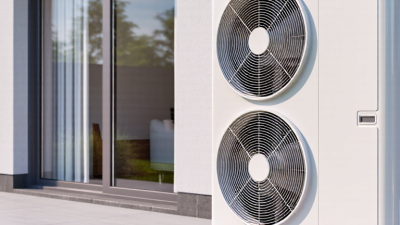
Installation decisions should begin with climate data, not showroom capacity. Air-source heat pumps suit moderate regions and many mixed-season homes. Cold-climate models need stronger defrost controls and reliable low-temperature output. Ground-source systems offer stable performance, but excavation requires space, soil testing, and higher upfront labor. Coastal buyers should request corrosion-resistant outdoor components. Salt air is unforgiving.

Correct sizing remains critical. An oversized unit may cycle frequently, waste electricity, and leave rooms damp. An undersized unit can struggle during freezing nights. Installers should check insulation, window leakage, duct condition, and electrical capacity before selecting equipment. Outdoor airflow must remain clear of fences, snow, and falling leaves. Condensate drainage also needs protection from freezing. Field inspections often find blocked drains and poor pipe insulation. Small errors become expensive later.

Maintenance should include filter cleaning every few weeks during heavy use. Outdoor coils need gentle cleaning, not aggressive pressure washing. Keep shrubs away from the fan outlet. A qualified technician should inspect refrigerant circuits, electrical connections, sensors, and defrost operation periodically. Humid climates may need more frequent coil checks because dust sticks to wet surfaces. Dry, dusty regions can load filters quickly. Maintenance schedules are useful, but they are not perfect. Household occupancy, pets, weather, and construction dust can change the real interval. In very cold areas, backup heat settings deserve careful testing before winter arrives.